Is the Serpent in Genesis the Devil?
Rethinking the Spirit World of the Bible through One Tricky Serpent
The Serpent in Genesis gets a pretty bad rap.
But this is understandable: the Serpent tricks humans into eating from a forbidden tree, severing humanity from its Edenic beginnings in the process.
The Serpent is punished: forced to crawl across the ground and live in enmity with humans. But hardly anyone reading Genesis feels much sympathy for this talking snake: he's the Devil, or 'Satan,' after all.
Isn't he?
Welcome to The Haunted Bible, a blog where I'll explore the unseen realms of the Bible through the various spirits, demons, ghosts, and fallen angels that 'haunt' its pages. I've spent most of my career researching, writing, and teaching about demons and fallen angels, and I'm currently writing a book on the 'ghosts' of early Christianity (more on that later!).
In this first post of a two-part series, I want to make a basic point: the spirit world of the Bible is not ours, and that matters for how we interpret biblical stories.
There's no better place to start than the Bible's very first book, Genesis. Here we find the famous creation stories of the Jewish and Christian traditions, with familiar figures like God, Adam, and Eve. But when we peer closer, we start to realize that some of the central figures in Genesis's creation accounts aren't all that they're made out to be.
After God has created the first human, he realized that his new creation lacked a certain something: "It is not good for man to be alone; I will make a fitting helper for him" (2:18). God then created the "wild beasts" and "birds of the sky," out of the very same earth from which he had created man (2:19). But "no fitting helper was found" (2:20). So God fashioned a "woman" as a helper for the man, from his very rib, such that they were from the same flesh (2:23).
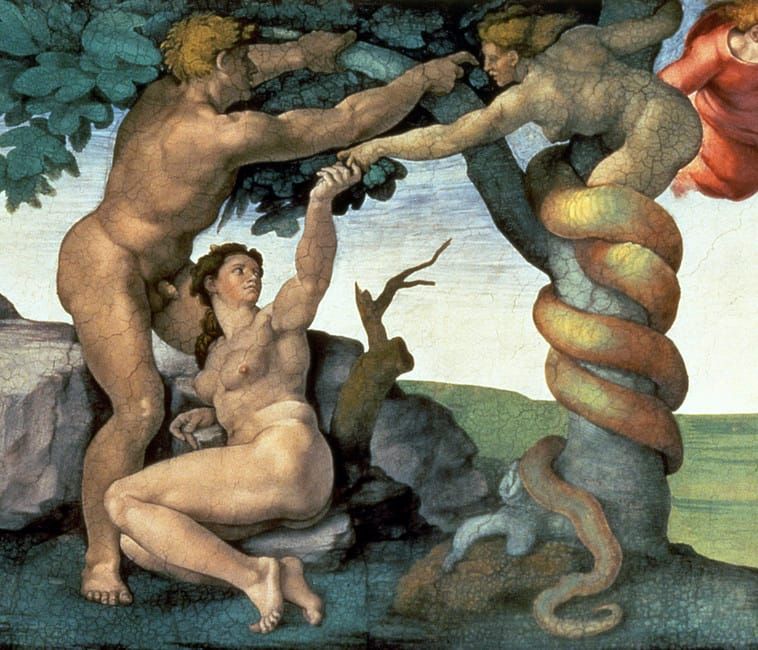
Enter the Serpent.
This animal was "the shrewdest of all the wild beasts that the Lord God had made" (2:26). The Serpent inquires of the woman: "Did God really say: You shall not eat of any tree in the garden?" (3:1). God had indeed directed the first human not to eat of the tree of knowledge of good and evil, warning that he would die if he did (2:17).
The Serpent seems to know about this rule, though his question about it is tricky: it doesn't quite square with God's actual commandment (which had allowed for eating from other trees) and so doesn't lend itself to a simple yes-or-no response.
The woman replies, correctly though inexactly, that she and the man "may eat of the fruit of other trees of the garden. It is only about fruit of the tree in the middle of the garden that God said, 'You shall not eat of it or touch it, lest you die'" (3:2-3).
The Serpent disagrees: "You are not going to die, but God knows that as soon as you eat of it your eyes will be opened and you will be like divine beings who know good and bad" (3:4-5).
On the surface, this looks like classic Satanic activity: defying the will of God and attempting to get humans to do the same. But in another way, the Serpent isn't behaving as we would expect of Satan or the Devil. Because the Serpent is telling the truth.
The woman takes the fruit of the forbidden tree and gives some to her husband (3:6). They both then experience not the death that God had threatened, but the awakening that the Serpent had foretold: "the eyes of both of them were opened and they perceived that they were naked" (3:7).
God later confirms that the Serpent was correct when he reveals why the man and woman must be expelled from Eden: "Now that the man has become like one of us, knowing good and bad, what if he should stretch out his hand and take also from the tree of life and eat, and live forever!" (3:22, emphasis mine).
God here confirms that humans have indeed gained knowledge, such that they've now become a threat to his very divinity. Or, in the words of the Serpent: their eyes have been "opened" so that they have become "like divine beings who know good and bad" (3:4-5).
What the Serpent anticipates, God affirms: the humans are kicked out of Eden not because they have died but because they're trending toward being gods themselves.
The Serpent here is no liar: he was telling the truth all along.
And this reveals an important point: the Serpent isn't a fallen angel or the 'Lucifer' of later lore. He's more like one of the "trickster figures" that we often find in storytelling traditions from across the globe. For comparison, think of the fox in many Native American tales or Prometheus in ancient Greek mythology.
Such tricksters aren't necessarily good or bad, but they are often wise, willing to disobey the (other) gods and the source for major developments in human history and culture. So also the Serpent.
There are other clues in Genesis that the Serpent isn't Satan.
First, the Serpent is never called 'Satan' or the 'Devil' or 'Lucifer'. Throughout the story he is identified simply as the Serpent. He's also never identified as a "divine being," or portrayed as a "fallen angel" (as Satan is later described). He is simply, if shrewdly, a "wild animal."
There's probably a good reason for this: the figure of "Satan" or the "Devil" was unknown to the writers of Genesis. It is only in later Hebrew Bible books, such as Job, that we meet a character called "the Satan" (more on that in future posts).
Second, the punishment of the Serpent makes much more sense if we think of this character simply as a shrewd animal, rather than as a fallen divine being. When God punishes the Serpent, he does so by making him...crawl like a snake.
"Because you did this, More cursed shall you be Than all cattle And all the wild beasts: On your belly shall you crawl And dirt shall you eat All the days of your life" (3:14).
The serpent isn't banished to hell, or cast from the divine court, or transformed into a Devil with horns and a forked tale: he's made into the serpent that would have been familiar to ancient writers of their day: one that crawls on the ground, has a tense relationship with humans, and is sometimes crushed by their feet (see 3:14-15).
In sum, the story of Genesis isn't the story of Satan or the Devil.
Instead, it's a folk etiology: a popular story that explains the origins of human experiences and helps its readers understand their world. It explains why humans have knowledge of good and evil, but are not immortal; it explains why farming and having children are difficult; and it explains why snakes seem to not get along too well with humans.
But what it doesn't explain is the origin of Satan. That will be have to wait for a later biblical story (and future blog post).
So, why does all this matter?
The lack of a Satan in Genesis should make us rethink our assumptions about the spirit world of the Bible. Namely: if we misread the Serpent in the garden as Satan, then what else are we missing about the gods, spirits, and demons of the Bible?
That will be the main focus of the blog posts to come: how the people writing and reading the Bible in its earliest settings had very different ideas than our own about spirits, angels, demons, and the cosmos that they populated.
Or, put another way: the Bible is often a lot weirder than we give it credit for. And to me, that makes it all the more interesting.
More on that next time on The Haunted Bible, where I'll ask: is the God of Genesis really the type of divine being we expect him to be?
Thank you for reading The Haunted Bible. Would you like to receive posts as soon they're published? Make sure to subscribe using the button below. And check out more of my work, Satan-related and otherwise, at www.traviswproctor.com.
Translation credit: all translations are from the New Revised Standard Version, Updated Edition (NRSVUE).