Why does God lie to Adam and Eve?

Reconsidering the Nature of the Divine in the Garden of Eden
What's up with God in the Garden of Eden?
In the first post on The Haunted Bible, I noted how the Serpent isn't quite who we expect him to be. Rather than a deceptive Satanic being, he's more like an ancient trickster figure: causing mischief, to be sure, but surprisingly honest and wise for a being so maligned by modern mythology.
Close readers may have also noticed something even more surprising: God in the garden behaves rather un-God-like: he shows ignorance, fear, and even lies to Adam and Eve. What gives?
Answering this question first requires explaining why God put the first humans in a garden in the first place.
In short: they're in the garden as...gardeners.
In the Ancient Near East, where Genesis was first told and written down, it was common for gods to create humans to do the labor they wished to spare themselves.
In the Atrahasis, an Old Babylonian creation myth dating to around the 18th century BCE (Before the Common Era), the "mother goddess" Mami creates humanity from a combination of earthly and divine material, then explains her motivations to the other gods: "I have relieved you of your hard work, I have imposed your load on man" (tr. Dalley, emphasis mine). The Enuma Elish, another ancient creation epic, similarly declares that humanity was created so that "the work of the gods shall be imposed (on him), and so [the gods] shall be at leisure" (tr. Dalley).
So also in Genesis. In the beginning there "was no man to till the soil" (2:5), and so God created man (from the dust, no less) "to till and tend" to the garden of Eden (2:15).
And this is our first clue that God in Genesis 2-3 is whole lot more human-like than we might expect: God didn't create humans out of divine goodwill, or just to show off his creative power. Rather, like a farmer who rents out his land to sharecroppers, God created humans to do some of his hard work.
As payment, God let humans eat from Eden's trees, with one exception: "as for the tree of knowledge of good and bad, you must not eat of it; for as soon as you eat of it, you shall die" (2:17).
God the landlord, the first humans his tenant farmers. So far, so good. For God, at least.
Until the mischievous Serpent comes along.
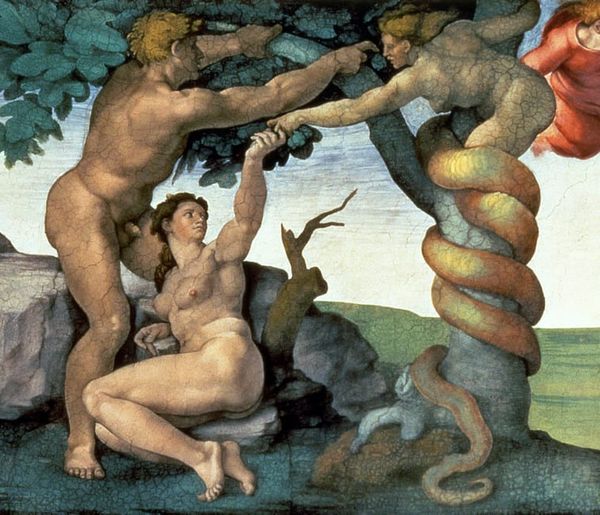
The Serpent informs the humans that God was not telling the truth when he told them that they would die if they ate from the 'forbidden' tree. The humans take from the tree, eat, and prove that God had lied: their eyes are opened thanks to their newfound knowledge, but they remain alive.
And for a God hoping to have a naive labor force, this is a problem. Once he finds out.
The humans hear God "walking in the garden" and they hide in shame (3:8). God seems unaware of where they are: "But the Lord God called to the man and said to him, "Where are you?" (3:9).
The first man admits to hiding himself out of fear of God and shame for being naked (3:10). God is perplexed: "Who told you that you were naked? Have you eaten from the tree of which I commanded you not to eat?" (3:11).
The man and woman have to explain to God what happened, with the man blaming the woman and the woman blaming the Serpent (3:12-13).
What's most notable here is that at each point in this story God is ignorant of the events that have unfolded. Like the humans he's created, there are limits to his knowledge.
We see God's shortcomings also surface in his motivation for banishing the humans. "Then the Lord God said, 'See, the humans have become like one of us, knowing good and evil, and now they might reach out their hands and take also from the tree of life and live forever – therefore the Lord God sent them forth from the garden of Eden, to till the ground from which they were taken" (3:22-24).
In other words, God fears the humans. They have become rivals, proximate to divinity thanks to their newfound knowledge of good and evil. For God, this is a bite too far.
So, why does God lie to Adam and Eve?
Because God was fallible, self-interested, and primarily interested in his own well-being. In other words, a lot like humans.
But this shouldn't surprise us, really: in the ancient Near East at the time of the Bible's writing, that's what gods were like.
In the Mesopotamian myth of Adapa, for example, the god Ea misleads the human Adapa, leading to the loss of immortality for humans. In the Atrahasis, the god Enlil sends plague, famine, and flood because the humans' noisy labor disturbs his sleep. In one Ugaritic myth, the god El (whose name is often used for the God of the Hebrew Bible) is portrayed as so drunk that he collapses in his own filth.
As seen with just these examples, gods in the ancient Near East were not the all-perfect, all-knowing beings that we tend to imagine today. (That's a product of later Platonic-Christian thinking). Instead, they were more often like flawed "superhuman" beings: powerful and immortal and knowledgeable, yes, but also selfish, morally capricious, and willing to lie or cheat if it served their own interests.
In this context, God's lie about the forbidden tree is less surprising. But it reminds us still: beware of bringing your own ideas of the divine (and other spirits) to the Bible. They might lead you up the wrong tree.
Thank you for reading The Haunted Bible. Would you like to receive posts as soon they're published? Subscribe here. And check out more of my work at my personal website.
Translation credits: Translations of Genesis are from the New Revised Standard Version, Updated Edition (NRSVUE). Translations of the Atrahasis and Enuma Elish are from Stephanie Dalley, tr., Myths from Mesopotamia, rev. ed., Oxford World's Classics (OUP, 2000).
For further reading on the human-like gods of the Ancient Near East, I recommend Dalley's Myths from Mesopotamia (see above) as well as Francesca Stavrakopoulou's, God: An Anatomy (Knopf, 2022).