Who was the Witch of Endor?
A Prophet's Ghost and 1 Samuel 28 Explained
In 1 Samuel 28, a desperate King Saul of Israel summons the ghost of the prophet Samuel using the services of a "witch" in the nearby city of Endor. In this first post of a series on The Haunted Bible, I explore what 1 Samuel really says about this witch figure, why Saul summons her, and the disastrous consequences that will follow.
Who was Saul?
According to the historical narratives of the Hebrew Bible, King Saul was the first king of the united monarchy of Israel, reigning sometime around the end of the 11th or beginning of the 10th centuries BCE (Before the Common Era). Scholars today have their doubts about whether Saul was really a king, as archaeological evidence doesn't provide much confirmation for Israel as a monarchy at this time. Nevertheless, Saul does appear to have been, at the very least, a major military figure whose leadership inaugurated or anticipated the rise of the Israelite monarchy and its later kings David and Solomon.
According to the biblical book of 1 Samuel, Saul became king when the prophet Samuel encountered him and informed him that the Israelite God has chosen him to rule over Israel. Saul is caught unawares: he was attempting to find his father's lost herd of goats, but ended up King of Israel!
And this sets the scene for Saul's later desperate visit to the Witch of Endor: Samuel was dead.
The Death of Samuel and Saul's Desperation
We pick up the narrative in 1 Samuel 28, when we learn of the death of the prophet: "Now Samuel had died, and all Israel had mourned for him and buried him in Ramah, his own city" (1 Sam 28:3).
This was a major blow to Saul: Samuel had been the guarantor of the king's royal claim and the mouthpiece for the Israelite God in Saul's court. And now was not a good time to be without divine counsel: Israel's hated rival, the Philistines, were encamped at Shunem preparing to make war.
Saul gathered his army, but was afraid of the Philistine host. When he sought the aid of God, however, he was rebuffed: "When Saul inquired of the LORD, the LORD did not answer him, not by dreams or by Urim or by prophets" (1 Sam 28: 6).
God has abandoned Saul. But why?
Saul's Fatal Error
For this, we look to an earlier episode in 1 Samuel: in the aftermath of a successful battle, Saul had spared the life of the Amelekite King Agag and some of the land's best livestock (1 Sam 15:7-9). This went against God's command to kill all the Amelekites, including the men, women, children, and livestock (see 1 Sam 15:3).
In response, God removes his favor from Saul: "I regret that I made Saul king, for he has turned back from following me and has not carried out my commands" (1 Sam 15:11). God's cold shoulder in 1 Sam 28 continues this narrative: God no longer favors Saul and will soon hand over Israel to a new king (David).
The Witch, the Ghost, and the Doomed King
With God out of the picture, Saul takes the situation into his own hands: "Then Saul said to his servants, 'Seek out for me a woman who is a medium, so that I may go to her and inquire of her.' His servants said to him, 'There is a medium at Endor'" (1 Sam 28:7).
Saul isn't supposed to be doing this. The Bible includes numerous bans on activities such as consulting 'mediums' or 'witches' (more on those terms and these bans in a later post). And Saul isn't just breaking biblical codes, he's violating one of his own policies. 1 Samuel earlier tells us that "Saul had expelled the mediums and wizards from the land" (28:3).
Based on these bans and Israel's penchant for monotheism (belief in only one God), one might expect Saul's journey to be unsuccessful. Witches and ghosts and magic are just a bunch of hocus pocus, right?
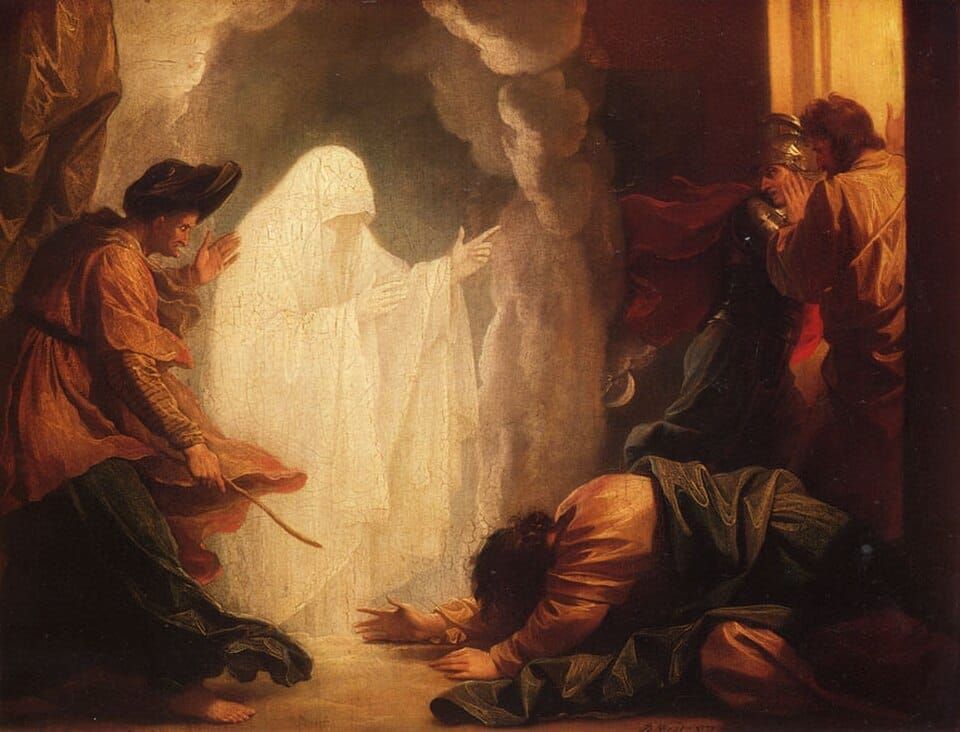
It's here where the Bible surprises us: Saul's visit to the witch of Endor actually works. According to 1 Samuel, Saul goes to the witch in disguise, asks that she bring up the ghost of Samuel, and she does so. Samuel's ghost rises from the underworld and informs Saul of his fate: the next day the Israelite army will fall to the Philistines, and Saul and his sons will die (1 Sam 28:19).
So, who was the Witch of Endor? Looking Ahead
A ghost, a witch, and a doomed king: the story of the medium of Endor in 1 Samuel is a key episode in Israel's early monarchy. It tells the story of the downfall of Israel's first king and how his fate was tied to religious disobedience.
But it also includes something rare in biblical narrative: a bona fide ghost story.
In the posts to come, I'll explore the ins and outs of the witch of Endor narrative, analyzing some of the most intriguing elements of the story's background and history, including:
~Was the 'witch' of Endor really a 'witch'? Why do some translations say 'medium' instead?
~Why are 'witches' or 'wizards' banned in the Bible?
~Did Samuel's ghost really rise from the dead, or was it a demon, like some later readers claimed?
~Where did ghosts come from? What was the underworld like in the Bible?
~Does this story show that the Bible's writers believed in ghosts? How does that square with Israelite monotheism?
Answering these questions will start to reveal that the Bible, and the world of the writers who created it, was a lot more haunted than we often realize.
Thank you for reading The Haunted Bible. Would you like to receive posts as soon they're published? Subscribe here. And check out more of my work at my personal website.
Translation credits: Translations of the Hebrew Bible (Old Testament) are from the New Revised Standard Version, Updated Edition (NRSVUE).